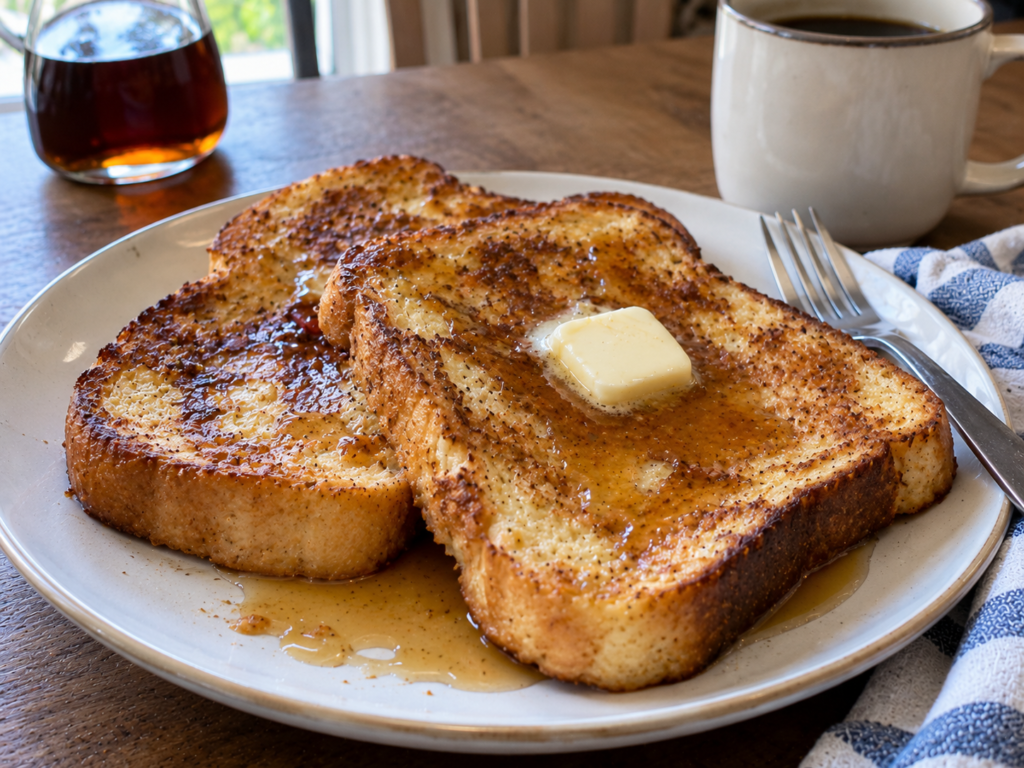
Homemade French toast is a classic breakfast favorite made with thick slices of bread dipped in a lightly sweetened egg-and-milk mixture, then cooked in butter until golden brown. The outside develops a lightly crisp surface while the inside stays soft, tender, and custardy.
Finished with a small pat of melting butter and a drizzle of maple syrup, this simple breakfast is comforting, satisfying, and easy to prepare with everyday ingredients.
Whether you’re making a relaxed weekend breakfast or a quick morning meal for the family, this easy French toast recipe delivers delicious results without complicated steps.
Why You’ll Love This Recipe
- Golden and buttery: Each slice cooks in butter until beautifully browned.
- Soft in the middle: The egg and milk mixture creates a tender, custard-like center.
- Simple ingredients: Uses bread, eggs, milk, cinnamon, and a few pantry staples.
- Quick breakfast: Ready in about 20 minutes.
- Easy to customize: Add fruit, powdered sugar, nuts, or your favorite syrup.
- Perfect for older bread: Slightly stale bread absorbs the custard without falling apart.
Preparation and Cooking Time
- Preparation time: 5 minutes
- Cooking time: 15 minutes
- Total time: Approximately 20 minutes
- Servings: 3–4
- Cooking method: Stovetop
Ingredients
- 6 thick slices of bread
- 3 large eggs
- ¾ cup (180 ml) whole milk
- 1 tablespoon granulated sugar
- 1 teaspoon vanilla extract
- ½ teaspoon ground cinnamon
- ¼ teaspoon salt
- 2 tablespoons unsalted butter, for cooking
For Serving
- 2–3 tablespoons maple syrup
- 1–2 tablespoons butter
- Powdered sugar, optional
- Fresh berries or sliced bananas, optional
Ingredient tip: Brioche and challah make especially rich French toast, but ordinary sandwich bread, Texas toast, or thick-cut country bread also work beautifully.
How to Make Homemade French Toast
Step 1: Prepare the bread
Choose thick slices of bread, ideally about ¾–1 inch thick.
If the bread is very fresh and soft, leave the slices uncovered for 20–30 minutes to dry slightly.
Slightly stale bread absorbs the egg mixture more evenly and is less likely to become soggy.
Step 2: Make the egg mixture
In a wide, shallow bowl, crack the eggs.
Add the milk, sugar, vanilla extract, cinnamon, and salt.
Whisk until the mixture is smooth and the eggs are fully incorporated.
Make sure there are no large streaks of egg white remaining.
Step 3: Dip the bread
Place one slice of bread into the egg mixture.
Allow it to soak for approximately 5–10 seconds on each side, depending on how thick and dry the bread is.
Turn it carefully so both sides absorb some of the mixture.
The bread should be moist but not falling apart.
Transfer the dipped slice to a plate and repeat with the remaining bread.
Step 4: Heat the skillet
Place a large nonstick skillet or griddle over medium to medium-low heat.
Add approximately 1 tablespoon of butter.
Allow the butter to melt and coat the bottom of the skillet.
The butter should gently sizzle without turning dark.
Step 5: Cook the French toast
Place 2–3 slices of dipped bread into the skillet, leaving a little space between them.
Cook for approximately 3–4 minutes on the first side, until the bottom develops an even golden-brown color.
Carefully flip each slice using a spatula.
Cook the other side for another 2–3 minutes until golden and the center is cooked through.
Adjust the heat if the outside is browning too quickly.
Step 6: Cook the remaining slices
Transfer the cooked French toast to a warm plate.
Add the remaining butter to the skillet and repeat with the rest of the bread.
Avoid overcrowding the pan because this can make the bread cook unevenly.
If necessary, cook in batches.
Step 7: Add the butter
Arrange the warm French toast on a breakfast plate.
Place a small pat of butter on top of the slices.
Allow it to melt naturally over the warm bread.
Step 8: Add maple syrup
Drizzle maple syrup lightly over the French toast.
Add powdered sugar or fresh fruit if desired.
Serve immediately while the edges are lightly crisp and the centers remain soft.
Tips for the Best French Toast
Use thick slices of bread
Thin bread can become soggy quickly. Thick slices provide a better balance between a golden exterior and a soft interior.
Slightly stale bread works best
Bread that’s a day or two old absorbs the custard without becoming overly soft.
Don’t soak the bread for too long
A brief dip is usually enough for ordinary sandwich bread. Denser bread can absorb the mixture for slightly longer.
Cook over medium-low heat
High heat can brown the outside before the egg mixture cooks through. Moderate heat gives the center enough time to set.
Use real butter
Butter adds a delicious flavor and helps create a golden surface. Wipe out the skillet if any butter begins to burn between batches.
Whisk the custard thoroughly
A well-mixed egg mixture coats the bread more evenly and prevents patches of cooked egg white.
Avoid overcrowding
Cook a few slices at a time so they brown evenly and are easy to flip.
Serve immediately
French toast tastes best straight from the skillet, when the edges are still slightly crisp.
Delicious French Toast Variations
Cinnamon French Toast
Increase the cinnamon to 1 teaspoon and add a small pinch of nutmeg to the egg mixture.
Serve with butter and maple syrup for a warm, spiced breakfast.
Vanilla French Toast
Increase the vanilla extract to 1½ teaspoons.
This gives the custard a slightly sweeter, bakery-style flavor.
Brioche French Toast
Replace ordinary bread with thick slices of brioche.
Its soft texture and buttery flavor create a particularly rich French toast.
Dip briefly so the bread doesn’t become too soft.
Stuffed French Toast
Spread cream cheese, peanut butter, or a little fruit jam between two slices of bread.
Press the slices together gently, dip them in the egg mixture, and cook as directed.
French Toast with Fresh Berries
Top the finished French toast with strawberries, blueberries, or raspberries.
Add a little maple syrup and powdered sugar.
Banana French Toast
Slice one ripe banana and arrange the pieces over the cooked French toast.
Add a drizzle of maple syrup and a sprinkle of cinnamon.
Brown Sugar French Toast
Replace the granulated sugar with 1 tablespoon light brown sugar.
The brown sugar adds a subtle caramel-like sweetness.
Dairy-Free French Toast
Replace the whole milk with unsweetened almond milk, oat milk, or soy milk.
Use a dairy-free butter alternative or neutral cooking oil.
Baked French Toast
Arrange the dipped bread slices in a lightly buttered baking dish.
Pour any remaining egg mixture over the bread and bake at 350°F (175°C) for approximately 25–30 minutes, until the custard is set.
This is a convenient option when preparing breakfast for several people.
Savory French Toast
Leave out the sugar, vanilla, and cinnamon.
Add a pinch of black pepper and a little grated Parmesan to the egg mixture.
Cook in butter and serve with cheese, sautéed mushrooms, or crispy bacon.
What to Serve with French Toast
French toast pairs well with both sweet and savory breakfast sides.
- Scrambled eggs: A simple source of protein alongside the sweet bread.
- Crispy bacon: Adds a salty, savory contrast.
- Breakfast sausages: A traditional breakfast side.
- Fresh strawberries: Bring freshness and natural sweetness.
- Sliced bananas: Pair beautifully with cinnamon and maple syrup.
- Greek yogurt: Adds a cool, creamy element.
- Fresh berries: A colorful and refreshing topping.
- Hash browns: A crispy savory addition.
- Coffee or tea: Perfect alongside a warm breakfast plate.
For a classic breakfast, serve French toast with butter, maple syrup, scrambled eggs, and a cup of coffee.
Make-Ahead Instructions
French toast is best freshly cooked, but you can prepare a few ingredients ahead of time.
Prepare the custard: Whisk the eggs, milk, sugar, vanilla, cinnamon, and salt together. Cover and refrigerate for up to 24 hours.
Prepare the bread: Slice the bread and store it in an airtight container or bread bag.
Cook when ready: Dip the bread just before cooking rather than leaving it soaking overnight.
Keep cooked slices warm: If preparing several batches, place the cooked slices on a baking sheet in a 200°F (95°C) oven while you finish cooking the rest.
Storage and Reheating
Refrigerator: Allow leftover French toast to cool, then store it in an airtight container for up to 3 days.
Freezer: Arrange completely cooled slices in a single layer on a baking sheet and freeze until firm. Transfer them to a freezer-safe bag or container, separating layers with parchment paper. Freeze for up to 2 months for best quality.
Refrigerator thawing: Thaw frozen slices overnight in the refrigerator, or reheat directly from frozen.
Oven reheating: Place slices on a baking sheet and heat at 350°F (175°C) for approximately 5–10 minutes, turning once if needed.
Toaster reheating: Place individual slices in a toaster or toaster oven until warmed through and lightly crisp.
Microwave reheating: Heat individual slices for approximately 20–30 seconds. The texture will be softer rather than crisp.
Frequently Asked Questions
What is the best bread for French toast?
Brioche, challah, Texas toast, and thick-cut white bread are excellent choices. They absorb the egg mixture while holding their shape.
Why is my French toast soggy?
The bread may have been too fresh, soaked for too long, or cooked over heat that was too low. Use slightly stale bread and dip it briefly before cooking.
Why is my French toast burnt outside but raw inside?
The skillet is probably too hot. Reduce the heat to medium-low and cook each side for a little longer.
Can I make French toast without vanilla extract?
Yes. Vanilla is optional. You can leave it out or add a little extra cinnamon instead.
Can I use water instead of milk?
You can, but milk produces a richer custard and better flavor. If necessary, use an unsweetened plant-based milk instead.
Can I make French toast without cinnamon?
Absolutely. Simply leave it out. You can replace it with a small pinch of nutmeg or keep the mixture plain.
How long should I soak the bread?
For ordinary sandwich bread, approximately 5–10 seconds per side is usually enough. Thick, dry bread may need slightly longer.
Can I use frozen bread?
Yes. Thaw the bread completely before dipping it in the egg mixture. Pat away excess moisture if necessary.
How do I know when French toast is cooked?
The outside should be golden brown, and the center should no longer look wet or contain liquid egg. If using a food thermometer, the center should reach 160°F (71°C).
Can I make French toast ahead of time?
Yes. Cook the slices, cool them, and refrigerate or freeze them. Reheat in the oven or toaster for a better texture.
Final Thoughts
Homemade French toast is one of the easiest ways to turn ordinary bread into a warm, satisfying breakfast. With a simple mixture of eggs, milk, cinnamon, and vanilla, each slice develops a golden exterior and a soft, custardy center.
The secret is to use thick bread, avoid soaking it for too long, and cook it slowly in butter until both sides are beautifully browned.
Finish with melting butter and a modest drizzle of maple syrup for a classic homemade breakfast.
Save this easy French toast recipe for your next relaxed morning breakfast!